
A TRV business Engineering Blueprint for Scalable Enterprise Design

THE TRV FRAMEWORK: OPERATIONAL SPECIFICATION
This framework serves as a practical, actionable guide for new entrepreneurs looking to launch a scalable startup. To ensure the concepts are highly operational rather than merely theoretical, real-world corporate examples and case studies are utilized throughout the text. Please note that TRV business operates independently and maintains no formal affiliation with, endorsement of, or responsibility for any of the enterprises cited; these organizations are referenced strictly as adaptable case models.
1. Core Framework Architecture
The traditional approach to launching a startup is a structural failure mode. Historically, entrepreneurs followed a linear, high-risk sequence: raise speculative capital, establish heavy fixed infrastructure, hire broad full time teams, and then attempt market validation. In volatile macroeconomic climates, this rigid model introduces extreme structural vulnerability.
The TRV (Target, Resource, Validate) Framework replaces speculative execution with a continuous, closed-loop feedback system. It treats enterprise design as an engineering discipline, minimizing capital expenditure while maximizing operational velocity.
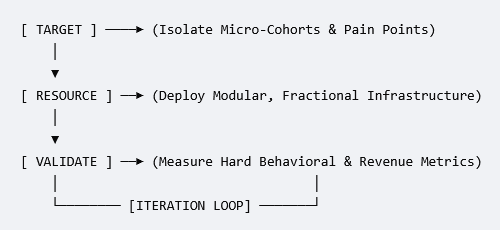
The system operates via three tightly coupled, deterministic phases:
Target (Hypothesis Isolation)
Instead of targeting broad, ill defined market verticals, the TRV framework demands the isolation of highly specific, non-obvious operational friction points within distinct micro-cohorts. Entrepreneurs must define their target through measurable, behavioral characteristics rather than loose demographics. The objective is to identify a systemic bottleneck where the economic cost of inaction for the customer significantly exceeds the price of the proposed technical solution.
Resource (Modular Infrastructure Injection)
The traditional paradigm dictates that an organization must own its resources to control them. The TRV Framework dismantles this assumption through Decentralized Resource Validation. Fixed operational overhead is an existential hazard. All core functions — software engineering, product architecture, growth marketing, regulatory compliance — are unbundled into modular, variable cost nodes. By utilizing global fractional networks and standardized interface protocols, the enterprise scales up capacity on demand and scales down to zero idle cost instantly.
Validate (Deterministic Loop Closure)
Validation is stripped of qualitative bias. The framework rejects superficial vanity metrics such as platform registrations, waitlist counts, or open rates. Instead, validation is governed strictly by hard, non-deceptive behavioral data: programmatic platform usage, continuous workflow retention, and non-refundable capital allocation (pre-orders, usage billing, or contractual commitments). If a target hypothesis fails to hit predefined quantitative thresholds within a strict time-boxed testing sprint, the resource node is reconfigured or depreciated immediately.
2. Strategic Execution & Implementation Metrics
Decentralized Resource Optimization
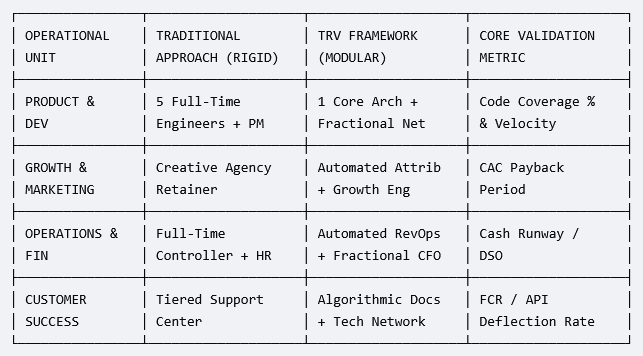
To engineer a scalable startup, fixed costs must be systematically converted into variable costs. The operational goal is to maintain a hyper lean core team focused exclusively on system design, business governance, and core intellectual property, while outsourcing execution to highly specialized, modular nodes.

The TRV target configuration dictates a Cost Flexibility Ratio of ≥ 4.0. This ensures that if market conditions shift rapidly, the organization's burn rate can contract by up to 80% within a single billing cycle without fracturing the core architecture.
High Velocity Iteration Mechanics
The velocity of an enterprise is the primary determinant of its survival. Startups do not fail because their initial hypothesis was incorrect; they fail because they execute too few iterations before running out of capital.

The TRV execution model prioritizes continuous, data driven optimization over multi-year strategic roadmaps. By breaking down development into 72-hour micro-sprints, the enterprise continuously adapts its product and positioning based on real-time feedback loops.
3. The Unified RevOps Tech Stack Architecture
To operate a highly responsive, decentralized enterprise without structural breakdown, manual human intervention must be systematically eliminated from routine data and administrative tasks. If an internal workflow requires an employee to manually copy data from one application to another, the system design is flawed.
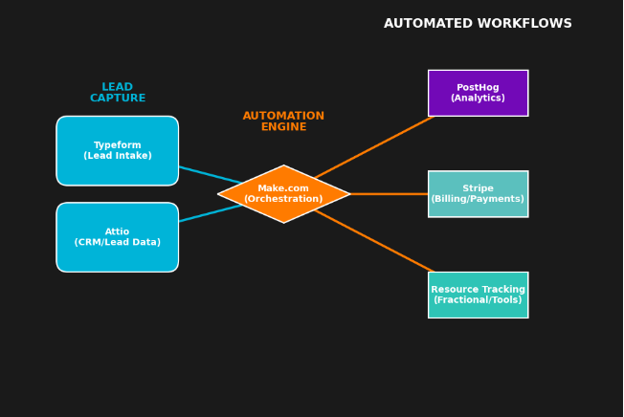
The architecture below illustrates the unified, automated data layer required to run a TRV startup. All system channels flow seamlessly into a centralized repository, eliminating internal data silos and maximizing operational velocity.
Production Integration Blueprint
1. The Single Source of Truth CRM
- Engine: Attio or custom-configured, API-first relational databases.
- Specification: Avoid rigid, out-of-the-box CRMs that enforce pre-packaged sales workflows. The data layer must dynamically ingest product telemetry events, contractual updates, and communication metadata into a single, highly indexable record.
2. The Automation & Orchestration Layer
- Engine: Make.com or self-hosted n8n nodes.
- Specification: All business logic is programmatically mapped within this layer. When an enterprise target interacts with a validation node, the orchestration engine executes multi-app workflows — enriching profile data via programmatic data clearings, verifying domain authority, and routing high value accounts instantly without human overhead.
3. Real-Time Behavioral Analytics Engine
- Engine: PostHog.
- Specification: Complete deprecation of superficial web tracking. The platform tracks exact user action paths, API call frequencies, and feature latency. Drop-off anomalies automatically trigger targeted, system driven interventions and alert product engineering nodes via automated communication webhooks.
4. Automated Metered Billing Infrastructure
- Engine: Stripe tightly coupled with Lago for open-source, usage based metering.
- Specification: Financial ledgers are tied programmatically to product consumption. As customers consume platform resources, billing records update in real time. This architecture completely eliminates manual invoicing, accurately calculates real time customer lifetime value, and prevents hidden revenue leakage.
4. Empirical Performance & Industry References
The validity of the TRV framework is supported by empirical shifts observed across global tech ecosystems. Industry benchmarks on operational velocity highlight that organizations utilizing automated, asynchronous operating workflows frequently experience accelerated delivery cycles and stark reductions in time-to-market compared to peer companies utilizing legacy enterprise communication structures.
Furthermore, a multi-year analysis published by the Startup Genome Project evaluating tech startup failure modes established that premature scaling is the primary driver of failure, accounting for 74% of high-growth startup collapses. This occurs when companies scale operations, specifically locking in massive, inflexible fixed overhead costs, prior to securing deep behavioral market validation.
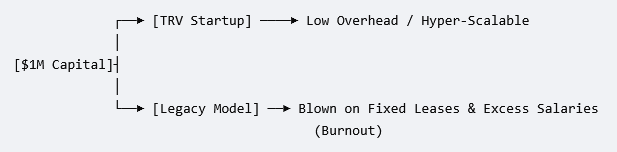
By enforcing strict, algorithmic validation gates before any capital allocation, TRV engineered startups achieve unparalleled efficiency metrics:

While traditional venture backed startups often maintain a Capital Efficiency Ratio of less than 0.5, organizations adhering to the TRV design continuously operate at a ratio of ≥ 1.5. This framework is structurally engineered to ensure that every dollar of capital burned yields a measurable, multiplying return in enterprise asset value.
5. Risk Assessment & Mitigations
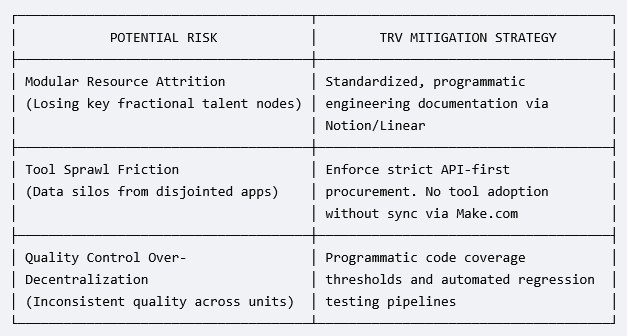
Risk: Modular Resource Attrition
Because the execution layer relies extensively on fractional talent networks, individual nodes may experience unexpected turnover.
- Mitigation: The system enforces a policy of strict operational transparency and universal code/process standardization. All workflows, system schemas, and architectural logs must be programmatically maintained within a centralized knowledge graph like Notion or GitHub. This ensures that any modular asset can be swapped out and replaced by an identical node within 4 hours, without institutional memory loss.
Risk: Tool Sprawl Friction
As specialized applications are introduced to handle distinct business operations, the data layer can experience structural degradation if too many mismatched systems are introduced without clear oversight.
- Mitigation: Establish a hard architectural rule: no software application may be added to the business stack unless it features a fully documented, open REST API or native webhook capabilities. Any platform that locks data within a proprietary ecosystem is completely banned from the infrastructure, ensuring that the central database remains the absolute source of truth.
Risk: Quality Control Over-Decentralization
Because the operational architecture distributes execution across autonomous business units and fractional nodes, output consistency can suffer from an alignment deficit if clear product benchmarks are not systematically enforced.
- Mitigation: Implement mandatory programmatic code coverage thresholds and automated regression testing pipelines within the core delivery architecture. Every asset, update, or package deployed by a decentralized node must trigger an automated integration loop that cross-checks the output against the system's baseline functional standards. If an update fails to hit the specified coverage metrics, the pipeline automatically rejects the deployment, ensuring that decentralization never compromises macro system reliability.
Unlock the TRV Precision Systems Engineering Protocol and build a high efficiency startup. Download the full PDF blueprint.