
How Many Types of Business Are There in The United States?

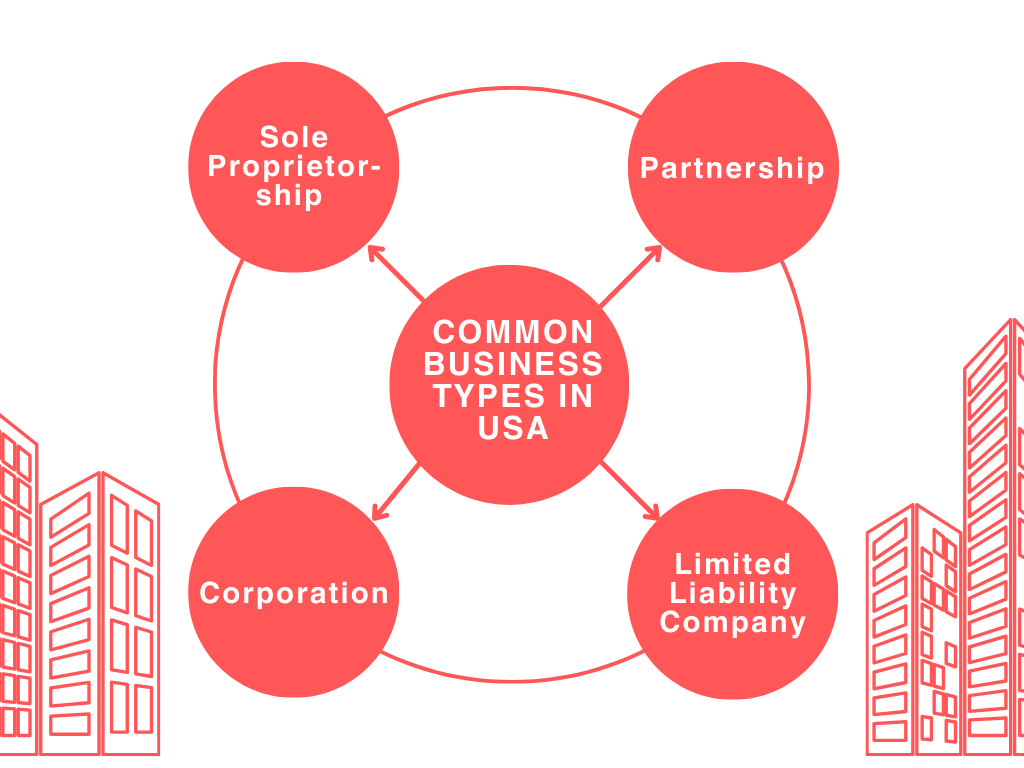
In this article, we will see the most common types of business in the United States, and within these types of business, TRV business helps many entrepreneurs to set them up and bring them to fruition. There are four very common types of business in the United States: sole proprietorship, partnership, limited liability company, and corporation. Please note that the focus is on for-profit businesses and not on types of organization. The list of very common types of organization in the United States could be much longer. We will, in fact, elaborate on each of these businesses mentioned here.
Sole Proprietorship: The sole proprietorship is the easiest to set up due to its structure. As the name suggests, it is owned by a single person, the owner, or it is a business that is not incorporated and there is no fair distinction between the owner and the business itself. Therefore, the owner, from a legal point of view, is responsible for all the actions and obligations of the business. And in terms of taxation, it is a disregarded entity (DRE), that said, the business is not taxed separately from its owner, preferably, its income and expenses are reported on the owner's tax return.
From a legal structure point of view, the sole proprietorship can be called a sole proprietorship by registering, if necessary, a business name also known as doing business as (DBA) or fictitious name, or it can also be called a single member limited liability company (SMLLC). Although a sole proprietorship as such is the easiest to set up, and in any case, it is very limited due to its single member structure. Because the sole proprietorship is tied or inherent to the identity of its owner under the law, it puts his/her personal assets at risk and at the same time causes distrust among investors to embark on such a business.
Partnership: The partnership is undoubtedly one of the most flexible business structures that allows several people to engage in a common business. Therefore, the partnership is a business that brings together at least two people who join their interests (pecuniary resources, material resources, knowledge, etc.) to build and manage a business. The partnership, after its creation, is often managed by its partners through a division of tasks to be accomplished and undertaken to achieve their objectives. However, the levels of responsibility and commitment of each partner depend on the type or form of partnership established.
Commonly, there are two types of partnership: Limited Partnership (LP) and Limited Liability Partnership (LLP). The LP is the type of partnership that has one partner who has unlimited liability unlike all other partners who themselves have limited liability. In this case, the notion of liability is subject to leadership and contribution, that said, the main entrepreneur or the person who has the most shares generally has control over the partnership and holds unlimited liability. The LLP, on the other hand, does not have a structure contrary to that of LP, it simply gives each of the partners a limited liability that goes hand in hand with their degree of contribution and involvement with regard to the partnership.
Talking about types of partnerships takes us straight to the agreement signed between the partners, which details the rights and responsibilities of each, the profit-sharing method agreed upon between them, etc. However, not all partnerships have a reference agreement in case of conflict and legal matters. As is well seen, a partner of a partnership, in point of fact, can be held accountable or not accountable for the debts and obligations of the enterprise and the actions undertaken in the name of the enterprise by the other partners.
And in tax terms, IRS (Internal Revenue Service) emphasizes that each partner of a partnership must declare his share of income or loss of the partnership in his personal income tax return, therefore, the partnership is held responsible to fulfill its tax obligations, but it does not pay income tax. The profits or losses of a partnership are, in this case, passed on to its partners.
Limited Liability Company: The Limited Liability Company (LLC) is arguably one of the most popular legal forms of business due to its flexibility in terms of management, taxation, and asset protection. The LLC mirrors the structure of each of the business types discussed in this article: the sole proprietorship, partnership, and corporation. That said, the LLC can be formed with one member (the owner), or with multiple members (the owners), however, the flexibility of an LLC will largely depend on the laws of the state in which the business is formed. The formation and governance of an LLC is governed by state law, which means that each state may have its own laws regarding an LLC.
What you need to know is that an LLC with a single member, just as true with multiple members, is considered separate from its owner unlike a sole proprietorship, and gives its owner civil protection although by default, in terms of federal taxation, it is considered a disregarded entity where its income and expenses are declared on its owner's personal tax return. Also, in terms of federal taxation, an LLC with at least two members is classified by default as a partnership where the profits or losses of each of its members must be reported on their personal tax return. An LLC that does not want to be treated as a disregarded entity or a partnership can file IRS Form 8832 to be treated as a corporation.
The LLC, as is well seen, can be an ideal choice for entrepreneurs, small and medium-sized businesses and industries, that seek to keep their personal assets separate and protected from their activities, and that seek increased flexibility in terms of management and federal taxation. Like any type of business structure that brings together at least two entrepreneurs, the LLC requires a formal agreement between the members for the smooth running of its operations and governance. In addition, the LLC, before and after its formation, must check with the state in which it will establish the laws relating to its operation and governance, because the LLC is above all a state-based business structure, which means each state has its own laws.
The Corporation: The corporation is undoubtedly the most robust business structure when it comes to autonomy, which means the corporation is like a person, well understood as a legal entity, in the eyes of the law. Simply put, the corporation is a legal entity separate from its shareholders or owners by providing them with limited liability. In fact, the corporation conducts business, undertakes its own affairs and is held accountable for its obligations, which leaves that the personal assets of its shareholders, so called, are kept separate and protected from its activities. This autonomy that the corporation benefits from, in fact, ensures its perpetual existence.
The ownership of the corporation is done through shares that can be sold to and bought by third parties especially when it becomes a listed or publicly traded company, in fact this form of legal structure that erects the corporation makes it a structure that attracts investors, high-caliber professionals and, above all, allows it to raise capital for its expansion and long-term sustainability. On the managerial level, the corporation involves the supervision of a board of directors who appoint the directors, implement and monitor the management policy of the company. From this, it is understood that the corporation is a medium and large company structure.
The corporation, in federal tax terms, is taxed twice, hence the concept of double taxation, which means the corporation as an autonomous legal entity file its own tax return and pays federal income tax on its net profit on the one hand, and when or if this profit or a portion, as dividends, is distributed to the shareholders, a second tax is applied on this same profit when the shareholders report this profit as dividends in their personal tax return on the other hand. By default, the corporation is treated and classified for tax purposes as a C Corporation which is the most common corporate structure, and which remains separate from its shareholders for tax purposes. However, the types of corporation include and are not limited to:
1. C Corporation: C Corporation, as we have just said, is the classic form of corporation, that’s to say it is an autonomous entity separate from its shareholders in the broad sense of the term.
2. S Corporation: An S Corporation is subject to direct taxation, meaning that its gains or losses are deferred on its shareholders' personal income tax returns to avoid paying federal income tax or being taxed twice as is the case with a C Corporation. To qualify as an S Corporation by the IRS, there are a number of criteria that must be met, and some states may take different tax approaches to S Corporations, and others may not consider an S Corporation to be an entity in and of itself.